Issue Briefs
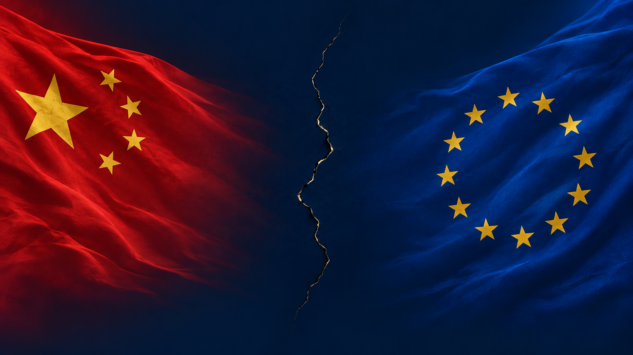
China’s Slow-Motion Crisis and Europe’s Exposure: GPI Occasional Paper
By Renato Caputo, Senior Advisor, Global Policy Institute.
October 5, 2026
China is not collapsing. Its economy is decaying, and Europe is paying a growing share of the bill. That is the central argument of a new GPI Occasional Paper by Senior Advisor Renato Caputo, China’s Slow-Motion Crisis and Europe’s Exposure: Finance, Property, and the Pressure on the Single Market.
Building on Logan Wright’s Broken China and on the debate CSIS hosted around the book on September 28, 2026, the paper describes a growth model that has run out of road. Property investment is in its fifth straight year of decline. Local government land revenue has collapsed, the GDP deflator was negative for three years, and household demand remains stagnant even as headline growth holds above 4 percent. Beijing has the administrative capacity to prevent disorderly failures. It does so by deferring and spreading losses, and the cost is a steady decline in the productivity of capital.
The adjustment China will not absorb at home is being exported abroad. Surplus manufacturing capacity is financed by a banking system bent to the goals of industrial policy and helped along by a real exchange rate the IMF considers undervalued by 12 to 21 percent. Since U.S. tariffs partly closed the American market, that surplus has been redirected to the European Union. The EU’s goods deficit with China reached €359.8 billion in 2025 and is on track to approach €400 billion this year. The ECB finds that Chinese imports are measurably pulling down euro-area goods inflation. Exposure is uneven across member states, with Germany, Central Europe, and Italy’s industrial districts most at risk. Brussels has responded with a permanent steel regime, antidumping duties on tires and tableware, and a new duty on low-value e-commerce parcels. Supply keeps shifting to whatever categories remain uncovered.
The paper concludes that the binding constraint in both Beijing and Brussels is political, not technical. Each capital has the tools it needs and hesitates over the distributional cost of using them. For Washington, the lesson is direct. Uncoordinated U.S. and European trade defenses push the Chinese surplus from one side of the Atlantic to the other. A coordinated response on steel, currency, chokepoint dependencies, and transshipment would close the escape routes that make unilateral measures leaky.
Download the full Occasional Paper (PDF): https://drive.google.com/file/d/1YsjR4A52IM7nc10ZQufm11xFMwQy1lDL/view?usp=drive_link
Legal Disclaimer:
The Global Policy Institute (GPI) publishes this content on an “as-is” basis, without any express or implied warranties of any kind. GPI explicitly disclaims any responsibility or liability for the accuracy, completeness, legality, or reliability of the information, images, videos, or sources referenced in this article. The views expressed are those of the author and do not necessarily reflect the opinions or positions of GPI. Any concerns, copyright issues, or complaints regarding this content should be directed to the author.
 |
Renato Caputo is Adjunct Professor of International Law and Security Regulations (GIUR-09/A) in the Second-Level Master’s Program in Information Science for Security at eCampus University (Novedrate, Italy) and Senior Advisor at the Global Policy Institute in Washington, D.C. He serves on the Advisory Board of the European Intelligence Academy in Athens, Greece; on the Scientific Committee of the review The Criminal Law of Globalization; and on the Scientific Committee, Historical-Diplomatic Area, of the review Europea. |