Issue Briefs
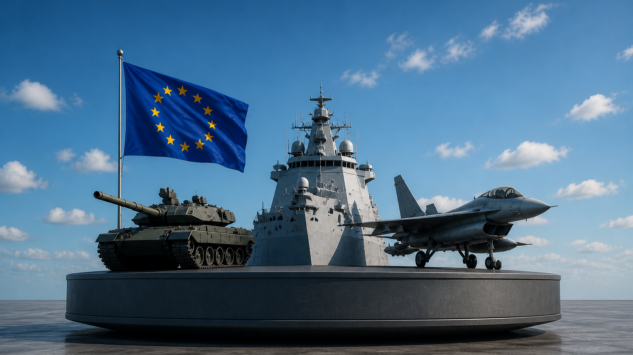
Defence Industries must be the Backbone of a New European Security Strategy
By Laetitia von Schönburg
May 5, 2026
The transformation of European defence is frequently characterised by renewed political commitment to improve countries’ security postures backed by increased defence spending. However, this perspective overlooks a more significant structural shift. Policymakers are increasingly identifying defence industrial capacity, rather than troop numbers or doctrinal reform, as the critical factor shaping a future European security strategy.
More than just money
This development reflects lessons learned from the ongoing conflict in Ukraine. Europe’s inability to sustain high-intensity warfare, support partners at scale, or credibly deter adversaries without a resilient, integrated, and technologically advanced defence industrial base has become evident. Ammunition shortages, fragmented procurement, and continuing reliance on United States systems have revealed systemic weaknesses that cannot be resolved through increased spending alone.
The emerging European approach increasingly positions a Europe-wide industrial policy as a core component of a new security policy. Initiatives at the European Union level, national rearmament programs, and cross-border industrial cooperation are converging to reduce strategic dependency and enhance Europe’s capacity as the main provider of the defence goods it needs. However, this transition remains incomplete. Ongoing fragmentation, fiscal constraints, and technological dependence continue to impede progress and raise questions about the timeline for achieving substantial strategic autonomy.
From Peace Dividend to Industrial Rearmament
For three decades after the Cold War, European defence policy was defined by contraction. Armed forces were downsized. Industrial capacity was consolidated or outsourced, and procurement was driven by cost efficiency rather than strategic resilience. The underlying assumption that Europe faced no immediate conventional threat proved durable, until 2022.
Russia’s invasion of Ukraine challenged this assumption. The conflict demonstrated the continued importance of industrial scale. Artillery shells, armoured vehicles, and logistics capacity, in addition to precision systems, have proven decisive in sustained conflict. Europe’s inability to rapidly replenish Ukrainian stockpiles exposed the extent of the of its defence industries’ decline and fragmentation. Production lines were limited, supply chains were globally dispersed, and coordination among Member States was minimal.
Become self-sufficient?
At the same time, uncertainty over US strategic priorities has reinforced the need for a significant growth of European industrial capacity. While NATO remains central, European policymakers increasingly acknowledge that continued reliance on US capabilities, particularly in intelligence, airpower, and advanced systems, creates strategic vulnerability.
Consequently, there has been a transition from a consumption-based security model, reliant on external guarantees, to a production-oriented model grounded in domestic and regional industrial capacity. This change is structural rather than cyclical, representing a fundamental reorientation of European security strategy.
Financial mobilisation and Readiness 2030
The EU’s recent initiatives mark a qualitative change in its guidance role. Programmes associated with Readiness 2030 and broader rearmament efforts are designed to mobilise large-scale financing, loosen fiscal constraints, and incentivise joint procurement. This reflects a recognition that national level efforts alone cannot generate the scale and coordination required.
The European Union is therefore repositioning itself as a defence enabler. Rather than replacing Member States, it is shaping incentives, reducing fragmentation, and supporting industrial expansion. This represents a significant departure from the EU’s historically limited involvement in defence.
The European Defence Industrial Strategy
The European Defence Industrial Strategy offers a clear articulation of the EU’s industrial ambitions. Its objectives, such as increased intra-European procurement, enhanced collaborative acquisition, and deeper market integration, are intended to address longstanding structural challenges. The primary issue is not a lack of defence spending, but rather a lack of coherence. This prevents economies of scale.
To date, the European defence market remains highly fragmented, characterized by multiple competing systems and limited interoperability. This fragmentation prevents economies of scale, increases costs, and undermines overall European industrial competitiveness. The new EU-wide strategy aims to address these issues by fostering a more integrated market.
However, the success of this strategy depends on sustained political commitment. At the national level, defence procurement is intricately linked to national sovereignty issues, employment, and support for domestic industries. Without a new political realignment, integration targets may remain aspirational rather than achievable.
Spending trends and strategic signalling
Defence spending across Europe has increased significantly since 2022. More notably, the composition of this spending has shifted. Investments are increasingly focused on increasing industrial capacity, research and development, and long-term capability generation, rather than short-term operational needs.
This trend suggests that European governments are not simply reacting to an immediate crisis. Rather, they are preparing for an extended period of geopolitical competition. The adoption of higher spending benchmarks reflects a broader recognition that defence will remain a structural priority.
What Would Military Self-Sufficiency Require
The ambition of reaching a European strategic autonomy is frequently invoked; but rarely defined. In practice, full self-sufficiency would require progress across four interdependent domains.
First, industrial capacity must be scaled up significantly. Europe currently lacks the ability to produce key munitions and platforms at the pace required for any sustained conflict. Expanding capacity requires long-term contracts, predictable demand, and integration of smaller firms into defence supply chains.
Second, technological sovereignty remains limited. European militaries continue to depend on US systems in critical areas, including advanced aircraft, missile defence systems, and intelligence capabilities. Closing this gap will require sustained investment in emerging technologies such as artificial intelligence, cyber capabilities, and space systems.
Third, supply chain resilience must be strengthened. Defence production depends on complex global networks, including access to critical raw materials. Disruptions, whether geopolitical or economic, pose significant risks to production continuity.
Fourth, procurement systems must be reformed. Europe’s fragmented procurement landscape results in duplication, inefficiency, and limited interoperability. Greater standardisation and joint acquisition are essential to achieving scale.
Collectively, these requirements underscore a crucial point: Europe’s primary constraint is organisational rather than financial. While resources (with exceptions) are generally available, they are not deployed efficiently.
National Dynamics: Convergence and Divergence
Despite growing EU involvement, defence policy remains fundamentally national. Member States differ significantly in their threat perceptions, fiscal capacity, and industrial priorities.
Eastern European states, particularly Poland and the Baltic countries, have adopted an urgency-driven approach, rapidly increasing spending, and prioritising deterrence. Their policies reflect proximity to Russia, and therefore a heightened perception of risk.
By contrast, larger Western European states face more complex trade-offs. France has long advocated for strategic autonomy and is positioning its industry accordingly. Germany’s Zeitenwende marks a significant qualitative and quantitative shift; but its implementation has been slower than anticipated due to bureaucratic and political constraints.
Southern European states, including Italy and Spain, have increased spending more gradually, as they are constrained by fiscal pressures and competing priorities.
This diversity of capability, threat perception and fiscal flexibility at the member states level complicates efforts toward integration. Although it enables tailored national responses, it simultaneously reinforces fragmentation. Aligning these divergent trajectories remains a central challenge for EU-level policy.
Cross-Border Cooperation Necessary but Difficult
Given the complexity of modern defence systems, no European state can achieve autonomy independently. Cross-border cooperation is therefore essential and structurally required.
Joint procurement initiatives and collaborative industrial projects offer clear advantages. They enable cost sharing, improve interoperability, and support the development of a more integrated industrial base. EU mechanisms are increasingly designed to incentivise such cooperation.
However, cooperation is also politically and economically complex. National governments remain inclined to favour domestic industries, even at the expense of efficiency. Divergent operational requirements and industrial strategies further complicate alignment.
This dynamic results in persistent tension. Although cooperation is widely recognized as essential, it remains consistently difficult to implement. Overcoming this challenge will be critical to the success of Europe’s defence transformation.
Timeline: How Realistic Is Strategic Autonomy
The timeline for achieving European military self-sufficiency is too optimistic. Although the new political momentum is strong, structural constraints impose significant limitations. In the short term, Europe will remain dependent on the United States for key capabilities. Industrial expansion takes time, and existing dependencies cannot be eliminated quickly. Increased spending can accelerate progress but cannot substitute for capacity that does not yet exist.
By 2030, EU initiatives may yield measurable improvements. Production capacity is likely to expand, and collaborative procurement may become more common. However, significant capability gaps, particularly in advanced technologies, will persist. Beyond 2030, Europe may achieve partial self-sufficiency defined as the ability to sustain operations and reduce reliance on external suppliers in selected domains. Full autonomy, however, is unlikely in the foreseeable future. This analysis suggests that strategic autonomy should be interpreted pragmatically. It does not imply complete independence from the US, but rather an enhanced capacity to act autonomously when necessary.
Structural Constraints
Three structural constraints will shape Europe’s trajectory.
First, fiscal sustainability remains uncertain. While political support for defence spending is currently strong, it may erode under economic pressures or shifting public priorities. The fact is that increased defence investment goals must compete with other budgetary demands.
Second, industrial bottlenecks limit the pace of expansion. Scaling production requires not only capital but also skilled labour, infrastructure, and stable supply chains. These constraints cannot be resolved quickly.
Third, political fragmentation continues to undermine integration. Divergent national interests and institutional inertia slow decision-making and complicate coordination.
Finally, technological dependence on the United States remains a critical constraint. Even with increased investment, closing the gap in advanced systems will take time.
Conclusion: Industrial Power as a Strategic Foundation
Europe’s defence transformation efforts are genuine, though still incomplete. The shift toward industrial rearmament reflects a deeper recognition that military capability is fundamentally linked to industrial and technological capacity. In this context, the defence industry is no longer merely a supporting element of security strategy, but its foundation.
The trajectory is evident: Europe is advancing toward a more capable and autonomous defence posture. However, progress is likely to be uneven, and expectations should be managed accordingly. Achieving strategic autonomy will require sustained efforts to integrate markets, align national policies, and invest in long-term capability development, rather than relying solely on declarations or spending targets.
The central issue is not whether Europe can increase defence spending, as this has already occurred, but whether industrial expansion can be translated into coherent and relevant operational capabilities. The outcome of this complex effort will determine whether European defense industries will emerge as credible foundations for EU-wide security, or remain structurally weak, this way forcing Europe to remain dependent on external actors for its own defence.
Legal Disclaimer
The Global Policy Institute (GPI) publishes this content on an “as-is” basis, without any express or implied warranties of any kind. GPI explicitly disclaims any responsibility or liability for the accuracy, completeness, legality, or reliability of the information, images, videos, or sources referenced in this article. The views expressed are those of the author and do not necessarily reflect the opinions or positions of GPI. Any concerns, copyright issues, or complaints regarding this content should be directed to the author.
 |
Laetitia von Schönburg is Director of Global Policy Institute Europe. She was born and raised in Germany. She holds a Comparative Literature and Culture degree from Royal Holloway University of London. Her academic background includes the Middle Eastern Studies Program at the University of Saint Joseph in Beirut and the History and Culture of Korea at Korea University in Seoul. |