Issue Briefs
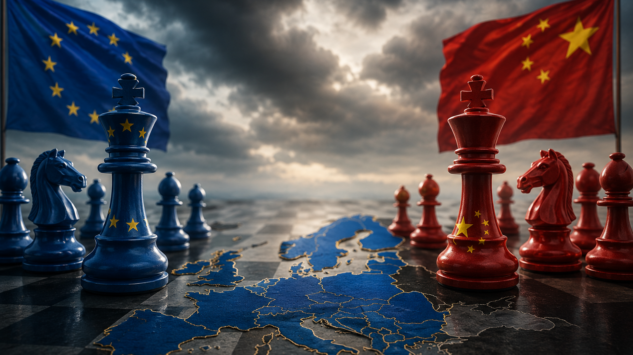
Europe’s facing the China challenge
by Massimiliano Cintura
July 21,2026
EU-China trade relations are shaped by China’s domestic imbalances that created chronic industrial overcapacity. The Chinese economy is characterized by a profound imbalance between the enormous capacity of its industrial base and the modest absorption capacity of its domestic market. On the one hand, there is chronic low domestic demand, mostly due to high rates of precautionary savings, fears over the sustainability of the social security system, and the huge losses suffered by middle class Chinese citizens due to the ongoing real estate crisis. On the other hand, Beijing has accelerated a massive influx of public capital, direct subsidies, and state-backed bank loans into advanced industrial sectors. This model, aimed at expanding “new productive forces” concentrates its efforts on specialty chemicals, biotechnology, and the pillars of the global green transition, such as electric vehicles, lithium-ion batteries, and the photovoltaic solar panel supply chain.
Sophisticated goods
The combined effect of this equation inevitably spills over into foreign markets, shaping what analysts term the “China Shock 2.0.” Compared to the first wave of exports in the 2000s, which focused on low-value-added goods, the current dynamic targets the technological sectors and advanced manufacturing. Because the United States have progressively sealed off their domestic market using tariffs and rigorous supply chain controls, the European Union has been left as the only large regional market that is simultaneously open, solvent, and highly capable of absorption. However, to understand the true scale of this phenomenon and Brussels’ reaction, it is no longer enough to examine the European trade deficit with Beijing solely in nominal monetary terms. Instead, a quantitative scrutiny of physical volumes is required.
Explosion of Chinese exports to the EU
Over the past decade, while the monetary value of the EU’s trade deficit with China has approximately doubled, the actual quantity of physical goods exported from Beijing—measured in metric tons—has increased more than fivefold. This gap provides empirical evidence of structural overcapacity and demonstrates how Chinese exports have transformed into a targeted deflationary pressure on the European single market. Chinese producers, cushioned by a state-supplied safety net that absorbs operating losses, providing at the same time subsidized credit, and artificially low domestic energy costs, are able to export massive volumes of advanced products. Given the subsidies the prices of these advanced Chinese products are systematically lower than the marginal production costs of Western competitors. Therefore, this is no longer a competition based on traditional process optimization, but a transborder transfer of a huge industrial production surplus that risks irreversibly eroding the profitability and the very survival of the European industrial base in high-tech sectors.
Formal transparency hides lack of access
The second “fracture” characterizing the European stance concerns the asymmetric nature of market access and the erosion of the principle of reciprocity. While Beijing’s official rhetoric promotes continuous international opening—backed by formal announcements such as the abolition of “negative lists” for foreign investors—this facade contrasts sharply with the empirical experience of European companies operating on Chinese soil. This outlines an institutional paradox in which the market of the People’s Republic of China on paper appears formally open while in reality it is a highly protected ecosystem.
Non-tariff barriers
Real access for would-be European exporters is hindered by a sophisticated web of non-tariff barriers that favor local industrial champions. Chief among these are the imposition of national technical standards deliberately misaligned with international practices, lengthy and opaque certification procedures handled with high degrees of administrative discretion, and informal requirements tied to localized research and development, forced technology transfer, and the enforcement of rigid national laws on data security and industrial data sovereignty. This legislation treats any corporate or technical information generated on Chinese soil as a strategic asset of the state, restricting the freedom of transnational corporations and subjecting them to constant inspections.
Public procurement restrictions
This asymmetry is evident in the analysis of public procurement, major infrastructure contracts, transport systems, and energy sector supply chains in China. In these areas, European firms remain systematically excluded, as tenders are structured to reward almost exclusively large Chinese State-Owned Enterprises (SOEs). Conversely, the European Union maintains a regulatory ecosystem designed for maximum accessibility, allowing any global actor to compete freely within the single market. This dynamic is forcing Brussels institutions to reconsider the core assumptions of their cooperation with Beijing.
Beijing’s counter-narrative on industrial competitiveness.
From Beijing’s perspective, the entire Western accusation regarding structural overcapacity is not viewed as an objective macroeconomic metric, but rather as a political construct. According to Chinese analysts, this concept is used instrumentally by the European Union and the United States as an ideological screen to justify a protectionist turn that violates World Trade Organization principles, with the ultimate goal of shielding obsolete domestic industries that can no longer keep pace with global competition.
The Chinese narrative maintains that the exceptional export capacity of its companies in the advanced mobility and clean energy sectors is the result of a genuine competitive advantage. This advantage was reportedly accumulated through decades of forward-looking investment in scientific research, extreme optimization of integrated domestic value chains, and fierce internal competition. From the Chinese viewpoint, if electric vehicles or solar modules produced in China feature competitive prices and high quality, it is due to unique economies of scale and coherent industrial planning. Beijing’s economists highlight that the difficulties facing European manufacturing stem from indigenous factors: skyrocketing energy costs following the decoupling from Russian gas, historical delays in digitalization, dependencies in raw material procurement, and an oppressive European bureaucratic framework that stifles innovation.
Furthermore, Beijing points out an intrinsic contradiction in the European Union’s political agenda. On one hand, Brussels proclaims itself a global leader in the fight against climate change, setting ambitious, legally binding decarbonization goals for 2030 and 2050. On the other hand, the implementation of punitive tariffs and restrictive measures on green industrial goods from China slows the adoption of clean technologies precisely where they are most needed, driving up the costs of the energy transition for European citizens and businesses alike. Viewed through this lens, Europe’s stance is described by China as an inconsistency that prioritizes the corporate protection of inefficient sectors over the supreme imperative of global climate goals.
National interests and the difficult synthesis of de-risking.
Formulating a coherent response to the multidimensional challenge posed by China represents one of the most complex tasks for the European Union, as community foreign and economic policy is fractured by deep divisions of interest among member states. The European Union operates as a complex negotiating arena where different models of capitalism, asymmetric industrial priorities, and diverging geopolitical sensitivities collide, making the search for a common policy toward Beijing a continuous exercise in mediation.
Export oriented economies
The axis of nations led by heavily export-oriented manufacturing economies, with Germany at its core, traditionally adopts a posture of extreme caution. For the German industrial complex (notably automotive and heavy chemicals), the Chinese market used to be a vital source of corporate revenue, a primary investment destination, and a foundational node in global supply chains. An open trade war or the imposition of steep tariffs targeting Chinese products would expose these export oriented economies to immediate, asymmetric retaliation from Beijing. China has leverage. It can target sectors like luxury goods and agrifood. It can block access to rare earth minerals and critical components essential for Western manufacturing.
Dirigiste economies
On the opposite side of the spectrum are nations like France, historically more inclined toward economic dirigisme and European industrial sovereignty. This second bloc exerts constant pressure on the European Commission so that the EU will assertively deploy all available trade defense instruments to shield the single market from deindustrialization and ensure the survival of strategic technological supply chains.
Seeking balance
Within this framework of internal fragmentation, relations between the European Union and China are moving along a path of progressive erosion. Faced with the impossibility of agreeing on a clean break, the European Commission has sought to forge a political synthesis through the doctrine of de-risking—the selective reduction of strategic vulnerabilities. This doctrine explicitly distances itself from the direct confrontation and total decoupling policy pursued by the United States. De-risking aims to isolate and protect high-value, highly critical industrial and technological sectors linked to national security, digital infrastructure, and dual-use technologies, while keeping normal trade routes open for traditional consumer goods. However, the dividing line between consumer goods and what falls under economic security has proven to be extremely fluid, turning every bilateral dossier into a flashpoint of geopolitical tension.
Integrated economic security
Since the World Trade Organization is facing real difficulties in resolving disputes over modern industrial state subsidies, the European Union’s strategic positioning is undergoing a significant evolution. There is a visible shift from a reactive posture to the active construction of an internal “regulatory shield” coordinated closely with G7 partners. This transition marks the definitive end of the long-held European illusion that global market integration would spontaneously guide Beijing toward Western-style regulatory and institutional convergence.
To compensate for the systemic competitive disadvantage arising from the impossibility of replicating China’s state-capitalism model—a limitation imposed by European state aid rules that bind the budgets of individual national governments—the European Union has begun rolling out third-generation trade defense instruments. These include regulations designed to monitor and, if necessary, exclude foreign companies that benefit from distortive state subsidies from participating in European public procurement tenders. In parallel, stringent reforms under the Cyber Security Act framework have been introduced, aimed at removing untrusted technology vendors or those subject to the control of autocratic governments from the continent’s communication networks and critical infrastructure. Synergistically, legislative initiatives like the Industrial Accelerator Act aim to boost domestic European productive capacity in key sectors of the green and digital transitions by introducing award criteria focused on environmental sustainability and supply chain resilience rather than just the lowest bid.
Defensive realism
In conclusion, the European Union is currently positioning itself within the global arena by adopting a stance of mature defensive realism. Aware that it cannot afford a traumatic rupture with the world’s second-largest economy, the EU is attempting to redefine the terms of economic coexistence through the rigorous enforcement of its regulatory power and the leverage of its single market.
The most complex challenge for Brussels over the coming decade will lie in its political capacity to preserve unity across so many member states. It will be vital to prevent Beijing from successfully using its established bilateral negotiation strategies—leveraging targeted investments or specific trade retaliation threats—to fragment European solidarity. Brussels must demonstrate that defending the single market is not synonymous with anachronistic protectionism, but rather the essential prerequisite for the survival of Europe’s continental strategic autonomy.
Legal Disclaimer
The Global Policy Institute (GPI) publishes this content on an “as-is” basis, without any express or implied warranties of any kind. GPI explicitly disclaims any responsibility or liability for the accuracy, completeness, legality, or reliability of the information, images, videos, or sources referenced in this article. The views expressed are those of the author and do not necessarily reflect the opinions or positions of GPI. Any concerns, copyright issues, or complaints regarding this content should be directed to the author.
 |
Massimiliano Cintura is a Global Policy Institute fellow. He received his MA in International Studies in 2025, from the University of Turin, Italy, with a dissertation on Frontex (the European Border and Coast Guard Agency). Prior to that he earned a BA in International Science, Development and Cooperation in 2023, with a dissertation on Eurojust (the European Union Agency for Criminal Justice Cooperation), also from the University of Turin. His areas of expertise and research focus include: International Relations, Global Affairs, Migration, Defense and Security issues. |