Issue Briefs
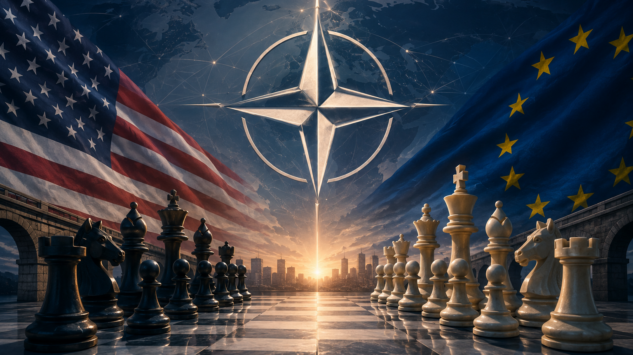
THE FUTURE OF NATO: BETWEEN AMERICAN AND EUROPEAN STRATEGY
By Massimiliano Cintura
July 17,2026
NATO was founded in 1949 in the aftermath of the Second World War to preserve peace and security across Western Europe and North America and to safeguard the freedom and security of all its members, against all threats, from all directions. Originally consisting of 12 countries, its membership now encompasses 32 allies. The Alliance’s founding principle of collective defense is “an attack against one is considered an attack against all.”
From the Cold War to strategic misalignment.
Established with the primary objective of achieving containment of the Soviet Union, the Alliance saw its original raison d’être vanish in 1991, embarking from that moment onward on a constant search for a new mission. Campaigns in the Balkans, Afghanistan, and Libya progressively transformed a regional defensive structure into an instrument of global power projection, raising significant questions regarding the actual convergence of interests between the two sides of the Atlantic.
Today, the eastward expansion of the 1999-2004 period – interpreted by the West as a legitimate process of democratic consolidation – manifests all its complexities and unresolved issues. While it answered the genuine security demands of former Soviet bloc nations, it simultaneously fueled a reaction from Russia, which viewed the process as a dangerous erosion of its historic buffer zones. The return of Moscow as a direct threat has reignited debates over the key NATO operational focus to NATO, but it has also exacerbated a deep asymmetry: while Washington views the confrontation with Russia as part of a broader global competition for hegemony (which includes the indirect containment of China), European capitals face an immovable geographic threat from post-Soviet Russia that jeopardizes security while forcing the Old Continent to seek alternate energy supplies.
The “America first” factor.
The current crisis of the Alliance is driven not only by external pressures but by a centrifugal force emanating from its very core. The Trump administration accuses Europe of free-riding on American military protection without paying its fair share. That’s why Washington also decided to downsize its military contingent in Europe through a revision of the NATO Force Model.
However, an analysis of the 2026 budgetary data gives us a picture that differs from the American perspective: while it is true that the United States continue to lead the Alliance by investing 3.19% of its GDP (accounting for a third of global military spending), Europe is no longer an inert bloc. Countries such as Poland, the Baltic republics, and Scandinavian partners now exceed the U.S. expenditure percentage relative to their national wealth. Germany itself has made a historic turn by doubling its defense budget over the last three years to reach 121 billion euros (2.39% of GDP).
Combined, NATO members represent over half of global military spending (approximately 56%). Consequently, the organization remains an unrivaled financial and technological colossus. That said, its internal political fragility undermines its capacity to mobilize its vast resources for international power projection. Furthermore, in the Global South NATO is widely perceived as a unilateral consortium defending the Western order, driving many emerging actors to look toward the BRICS as an alternative seeking to create multipolar political and commercial architecture.
Brussels’ response: the E3 Axis and the “associate member” architecture.
Europe finds itself forced to transition from being a consumer to a producer of security. Signals from the ministerial summit in Helsingborg this past May indicate that European chanceries are attempting to turn the American retrenchment into an opportunity for a European strategic emancipation. German Foreign Minister Johann Wadephul’s declaration regarding Berlin’s readiness to assume a leadership role – in coordination with Paris and London within the E3 format – outlines a collective will to reshape burden-sharing at the upcoming Ankara summit.
Integrating Ukraine
The most politically significant move within this strategy concerns the future of Ukraine. Faced with the uncertainties of the Atlantic umbrella and seeking to bypass formal vetoes against Kiev’s immediate NATO entry, the European Union is evaluating the creation of an “associate member” status for Ukraine. While stopping short of granting voting rights, this formula would extend the application of Article 42.7 of the Treaty on European Union to Kiev. This would represent a pivotal shift: Europe’s mutual defense clause would be deployed to secure Ukraine, shifting the axis of deterrence from the Pentagon to European capitals.
Defense industries cooperation
This German-led acceleration is also reshaping industrial relations within NATO itself, as evidenced by the growing defense procurement alignment between Germany and Turkey. However, the path toward a solid European pillar is fraught with internal obstacles. France views Berlin’s leadership ambitions with marked caution, fearing a geopolitical imbalance and recognizing the risk that increased military spending might result in further technological dependency on the transatlantic defense industry rather than genuine European sovereignty.
Subordination?
NATO stands now at a historic crossroads where survival or dissolution are both possible outcomes that depend on its members’ capacity for structural adaptation. Under the scenario of permanent subordination, Europe will continue to increase its military budgets in a fragmented manner, remaining a secondary actor and enduring Washington’s strategic agenda even in quadrants detached from its immediate priorities, such as the Indo-Pacific or trade disputes over Arctic shipping routes.
Balanced partnership
Under the scenario of a balanced partnership, NATO will restructure itself around two cooperative pillars. Europe will assume full financial and operational responsibility for deterrence on the Eastern Flank and crisis management in its neighborhood (the Middle East and the Mediterranean), offering Washington the requested retrenchment without compromising the cohesion of the transatlantic bloc.
Fragmentation
Under the scenario of fragmentation, mutual distrust among European partners (primarily the Franco-German fault line), the geopolitical ambiguity of key members like Turkey, and a persistent American isolationist stance will paralyze Article 5 decision-making mechanisms, reducing the Alliance to a formal bureaucratic shell, this way accelerating the transfer of global influence toward competing poles in the Global South.
Priorities for Europe
For European policymakers, the preeminent strategic recommendation is to avoid passively enduring the realignment of the U.S. contingent. It is a priority to harmonize the defense expenditures of individual member states through joint procurement programs and, above all, to institutionalize the European Union’s mutual defense mechanisms as a necessary, rather than subordinate, complement to the transatlantic alliance.
Legal Disclaimer
The Global Policy Institute (GPI) publishes this content on an “as-is” basis, without any express or implied warranties of any kind. GPI explicitly disclaims any responsibility or liability for the accuracy, completeness, legality, or reliability of the information, images, videos, or sources referenced in this article. The views expressed are those of the author and do not necessarily reflect the opinions or positions of GPI. Any concerns, copyright issues, or complaints regarding this content should be directed to the author.
 |
Massimiliano Cintura is a Global Policy Institute fellow. He received his MA in International Studies in 2025, from the University of Turin, Italy, with a dissertation on Frontex (the European Border and Coast Guard Agency). Prior to that he earned a BA in International Science, Development and Cooperation in 2023, with a dissertation on Eurojust (the European Union Agency for Criminal Justice Cooperation), also from the University of Turin. His areas of expertise and research focus include: International Relations, Global Affairs, Migration, Defense and Security issues. |