Issue Briefs
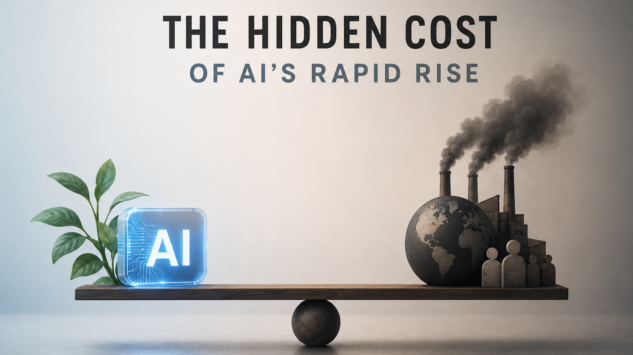
The Hidden Cost of AI’s Rapid Rise
By Dr Nishakant Ojha
June 27,2026
Every technological revolution comes with a bill. The steam engine blackened cities. The automobile reshaped landscapes. Social media rewired attention. Artificial intelligence is no different. The difference is that this bill is arriving before most people have even realized they’ve ordered the service. The problem with AI was never going to be technology. It was always going to be the speed. In a few short years it has slipped into our inboxes, our classrooms, and our decisions, used by hundreds of millions of people who would struggle to say how it works or what it takes to run. Tools usually arrive slowly enough for us to take their measure. This one didn’t –and the bill for that haste is already coming due, mostly in places we aren’t looking. A handful of those harms are worth examining closely: the toll on the environment, the slow dulling of human thinking, the damage to the information everyone relies on, and the quiet concentration of power in a handful of companies.
A Cost Nobody Wants to Measure
The machinery behind AI is vast, and the environmental cost is no longer a guess. A 2025 study in Cell Reports Sustainability put the carbon footprint of AI systems at somewhere between 32.6 and 79.7 million tons of CO₂ for the year, and the water footprint at 312.5 to 764.6 billion liters-roughly what the world drinks in bottled water annually. The high end of that carbon estimate is close to what a small European country emits in a year.
And the numbers keep climbing. A United Nations University report from mid-2026 found that data centers worldwide used about 448 terawatt-hours of electricity in 2025. If they were a country, that would rank them eleventh in the world for power consumption. AI accounted for roughly a fifth of it. By 2030, the report projected, data-center electricity use could reach 945 TWh, with a water footprint of 9.3 trillion liters and a land footprint of more than 14,500 square kilometers.
Two things tend to get missed in all of this. The first is that the burden has shifted from training a model to running it. Once a system is live, the billions of everyday queries it handles eat up an estimated 80 to 90 percent of its lifetime energy –so the cost rises exactly as the tool catches on, and people start to depend on it. The second is water, which barely shows up in company reports. The water evaporated by the power plants supplying these data centers usually runs three to four times higher than what’s used on-site for cooling, and almost no one discloses it. Researchers keep pointing out that no major operator publishes AI-specific environmental figures at all, which leaves the public guessing from broad performance data. For a technology that consumes this much, there is strikingly little honesty about what it actually takes from the planet.
The Quiet Erosion of How We Think
The planet isn’t the only thing paying for AI’s spread. Some of the cost lands much closer to home –on thinking itself. Handing mental work over to a machine is easy, and researchers have a name for it: “cognitive offloading.” It also seems to carry a price you can measure. In a 2025 study, Michael Gerlich surveyed 666 people of different ages and education levels and found a clear pattern: the more someone leaned on AI tools, the weaker their critical thinking tended to be, with offloading as the link between the two. The youngest group, ages 17 to 25, showed it most plainly. They relied on AI the most and scored the lowest. More education seemed to soften the effect, though it didn’t erase it.
That study isn’t alone. At the MIT Media Lab, researchers tracked the brain activity of people writing essays-some using ChatGPT, some using a search engine, some using nothing. The ChatGPT group’s brains were the least engaged, and they came up short across neural, linguistic, and behavioral measures. The pattern researchers describe is a loop that feeds itself. AI hands back clean, confident answers, which makes it tempting to offload a little more next time, and the less anyone practices working through a problem, the weaker that muscle gets. Some scholars have started using uneasy phrases for it-“cumulative deskilling,” “metacognitive passivity”-the slow loss of exactly the skills needed to tell whether an AI’s answer is any good in the first place.
What makes this hard to notice is that it feels like the opposite. The work gets done faster, the output looks sharper, and the sense is one of getting better at things. Underneath, the skill is thinning out. People feel more capable as they grow less so –and that gap between feeling and reality is a real part of the danger.
When Seeing Stops Believing
If AI quietly weakens our ability to judge what’s true, it’s also flooding the world with more that’s false. Making a convincing lie used to take effort. AI has stripped most of that effort away, and the damage to our shared sense of what’s real is already showing. The European Parliamentary Research Service estimated that deepfake videos online jumped from around 500,000 in 2023 to 8 million in 2025 –sixteen times more in just two years. And the tools themselves aren’t reliable narrators: a NewsGuard report found that leading AI chatbots repeated false claims about a third of the time when asked about contested topics.
None of this is theoretical. In 2024, scammers used a deepfake to pose as a company’s CFO on a video call and walked an employee into wiring them $25 million. Deloitte expects generative AI to push U.S. fraud losses from $12.3 billion in 2023 to $40 billion by 2027. And deepfakes have become a common weapon for non-consensual sexual imagery and for online abuse aimed at driving women and minorities out of public life.
But the deeper problem isn’t any single scam. It’s what happens to trust itself. Researchers call it the “liar’s dividend”: once everyone knows a video might be fake, real footage can be waved away as fake too, and a politician caught on camera can simply deny it ever happened. UNESCO calls this a “crisis of knowing” –a moment when seeing and hearing stop being enough to believe something. When faith in all information drains away at once, you don’t end up with a sharper public. You end up with one that’s more cynical, more divided, and easier to manipulate. The GoLaxy documents that surfaced in September 2025-describing an AI system that built psychological profiles of roughly 2,000 public figures to feed them tailored propaganda– show just how industrial this can get.
A Lot of Power in Very Few Hands
All of this –the resource drain, the dulled thinking, the polluted information– shares a root. The most capable AI systems are built and run by a small group of deep-pocketed companies, simply because training a frontier model takes capital, data, and computing power that almost no one else can assemble. And as people, businesses, and public institutions fold these tools into their everyday work, they hand a growing share of their dependence to a few private firms-firms whose goals may not match the public’s, and whose products can change overnight, break, or vanish with little anyone can do about it.
The thread tying all of this together is pace. Environmental costs are piling up before there are even standards to measure them. AI is reshaping how a generation of students thinks faster than teachers can adjust. Jobs are shifting before retraining programs can catch anyone who falls. The information ecosystem is being flooded faster than detection tools, laws, or basic social habits can respond. As one wide-ranging 2025 assessment put it, regulators still haven’t found workable ways to deal with the fallout. Technology isn’t waiting for any of us to be ready.
Slowing Down Enough to Look
None of this says AI is bad, or that its real benefits –in medicine, research, accessibility, the sheer amount of work it can take off people’s plates– aren’t real. The argument is narrower than that. It’s against speed without thought. The same tool can help cure a disease or help hollow out a democracy, and which one it does comes down to how carefully it’s put to use. The sensible stance isn’t to reject AI or to swallow it whole. It’s to insist on the conditions that let the good outpace the harm: companies made to disclose what they consume, schools that build thinking rather than outsource it, labor policy that catches the people a transition leaves behind, real standards for telling genuine media from fake, and a market that doesn’t let a few firms own everything.
The danger isn’t that AI is becoming powerful. The danger is that it is becoming indispensable before we have decided what it should cost. Every query, every convenience, every shortcut comes with a bill. The environmental cost, the cognitive cost, the social cost, and the democratic cost may not appear on a monthly statement, but they are being paid nonetheless. The question is not whether AI will shape the future. It already is. The question is whether we will examine the invoice before it’s too late to dispute the charges.
Legal Disclaimer:
The Global Policy Institute (GPI) publishes this content on an “as-is” basis, without any express or implied warranties of any kind. GPI explicitly disclaims any responsibility or liability for the accuracy, completeness, legality, or reliability of the information, images, videos, or sources referenced in this article. The views expressed are those of the author and do not necessarily reflect the opinions or positions of GPI. Any concerns, copyright issues, or complaints regarding this content should be directed to the author.
 |
Dr. Nishakant Ojha is a Senior Advisor of the Global Policy Institute in Washington D.C and the Director of the Global Policy Institute, India. He is a globally acclaimed expert in counterterrorism and strategy, who has influenced national security policies, providing strategic defense guidance to multiple allied nations. |